

The Evolution of Football Tactics: From Catenaccio to Gegenpressing
Why Tactics Matter: The Game Behind the Game
Football tactics are the invisible architecture beneath every match you watch. Understanding them transforms you from a passive spectator into someone who can read the game — spotting why a team suddenly wins back possession, or why a dominant side concedes against the run of play.
The history of tactical evolution is also a history of football itself. Each era produced a system in direct reaction to what was dominant before it, like a game of strategic chess played across decades. When you trace that thread from Catenaccio to Gegenpressing, modern matches start making a lot more sense.
Catenaccio: Defending as an Art Form
Catenaccio — Italian for "door bolt" — is a defensive system built on rigorous man-marking, a withdrawn libero sweeper, and the principle that a clean sheet is always worth more than a goal. It dominated European football through the 1950s and 60s, and it shaped how the continent understood defensive organisation for decades.
The system reached its peak under Helenio Herrera at Inter Milan, whose "Grande Inter" sides won back-to-back European Cups in 1964 and 1965. Herrera's implementation was meticulous: outfield players tracked their direct opponents relentlessly, while a libero positioned behind the defensive line covered for any errors and swept up loose balls. Space was eliminated. Transitions were neutralised before they started.
The genius of Catenaccio wasn't merely passive defending — it was the deliberate manufacture of a low-risk environment in which a single counter-attack could win matches. Teams would invite pressure, absorb it, then explode forward in transition. Sound familiar? That logic never left football.
Its weakness was obvious in hindsight: it required opponents to come forward and offered little when facing equally cautious sides. That limitation created the conditions for something radical to emerge.
Total Football: When Positions Became Fluid
Total Football rejected the fixed roles that Catenaccio depended on. Developed by Rinus Michels at Ajax in the late 1960s and exported to the Netherlands national team at the 1974 World Cup, the system proposed that any outfield player could occupy any position — provided his teammates rotated to fill the space he vacated.
This required extraordinary technical quality and spatial intelligence across the entire squad. Johan Cruyff was its most famous embodiment: a nominal forward who dropped deep, drifted wide, and organised the press from the front. When one player moved, the whole structure shifted in response, like a flock moving in unison.
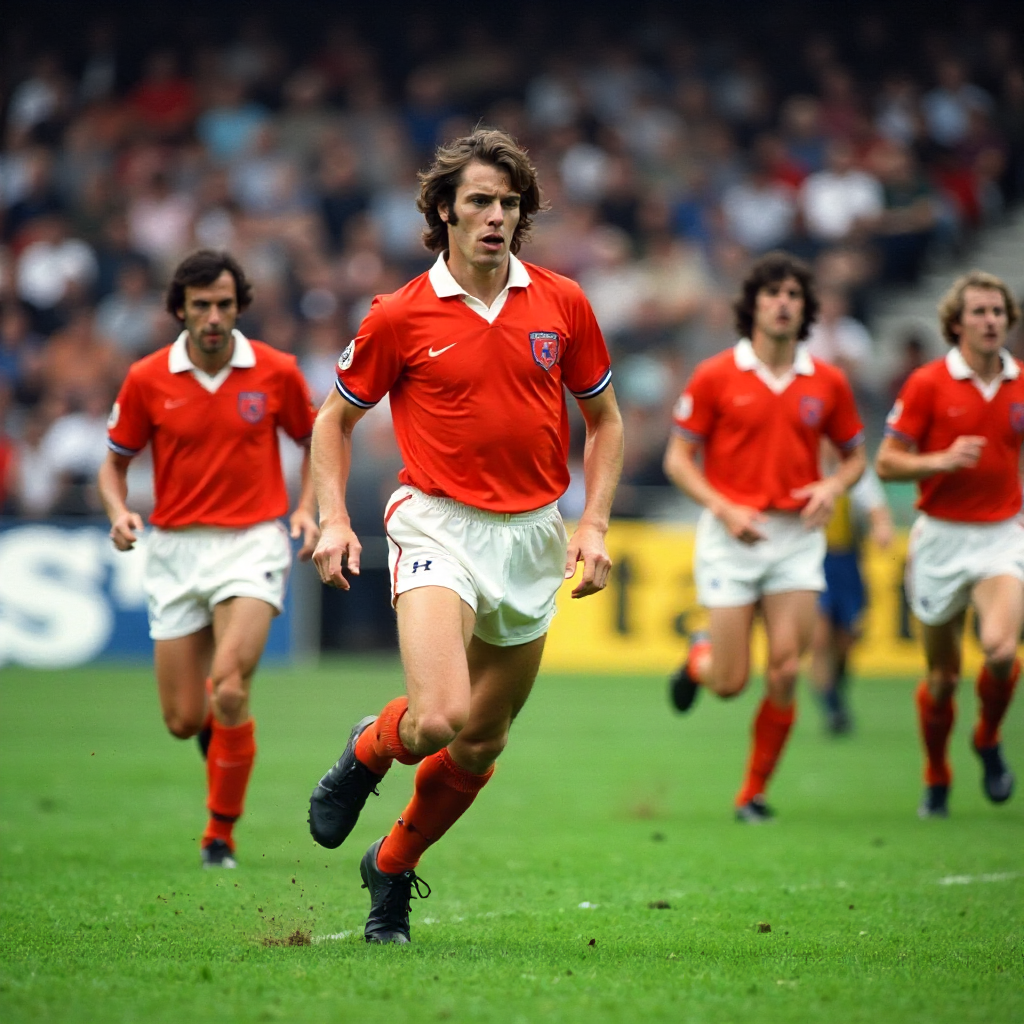
The tactical implication was profound. Defending suddenly meant collective positioning rather than individual marking. Attacking meant occupying and exploiting space, not just running in straight lines behind a lone striker. These ideas about space and positional intelligence became the shared language that later generations of coaches would build upon.
Total Football didn't win the 1974 World Cup — the Netherlands lost the final to West Germany — but it won the argument about the future of the game.
The Pressing Revolution Begins: Sacchi's Milan
Arrigo Sacchi's AC Milan sides of the late 1980s represent one of the most consequential — and most underappreciated — pivots in football history. Sacchi introduced collective pressing not as an occasional tactic but as a continuous, systemic defensive weapon.
His Milan operated with a high defensive line, compressing the vertical space available to opponents and forcing errors in dangerous zones. When possession was lost, players didn't retreat — they pressed immediately, as a coordinated unit, cutting off passing lanes and recovering the ball high up the pitch. The 4-4-2 formation became a pressing machine rather than a passive defensive shape.
Sacchi won two European Cups (1989, 1990) without a single world-class defensive midfielder. He famously argued that technical quality mattered less than collective understanding — a heretical statement in an era when Italian football still worshipped individual ball players. His teams won because every player knew exactly where his teammates would be, at every moment.
This idea — that the team moves as one organism — is the direct ancestor of both Tiki-Taka and Gegenpressing. Sacchi sits at the hinge between the old world and the new, and most tactical histories don't give him nearly enough credit for it.
Tiki-Taka and the Age of Possession
Tiki-Taka, as developed by Pep Guardiola at FC Barcelona between 2008 and 2012, turned ball retention into a method of control. The logic was elegant: if your team has the ball, the opposition cannot score. Possession itself became a form of defending.
Guardiola's Barcelona — built on the La Masia academy's technical foundation and the positional play principles Cruyff had embedded at the club — dominated European football with short passing combinations, relentless movement into pockets of space, and an almost supernatural ability to suffocate opponents without the ball. The 4-3-3 provided the attacking width; the midfield diamond provided the numerical overloads in central areas. Xavi, Iniesta, and Busquets became the physical manifestation of positional play theory.
The system required extraordinary squad homogeneity. Every player had to press from the front, recycle possession quickly, and understand their role in maintaining compactness when out of possession. The trade-off was significant: without the right profiles in every position, it simply didn't work. Attempts to replicate Tiki-Taka elsewhere — at the Spanish national team's peak and in various continental imitations — ranged from brilliant to laboured depending almost entirely on the quality of central midfield.
By the mid-2010s, opponents had found answers. Sitting deep in a low block and playing on the counter against a possession side created problems that pure retention couldn't always solve. A different kind of response was already taking shape in Germany.
Gegenpressing: Chaos as a System
Gegenpressing — counter-pressing — is built on a single insight: the moment immediately after losing possession is the best moment to win it back. At that instant, the opposition is disorganised, their players are out of position, and the ball carrier is often surrounded. Jürgen Klopp at Borussia Dortmund turned that window of chaos into a repeatable tactical weapon.
Rather than retreating into a defensive shape after losing the ball, Klopp's teams would press immediately and aggressively, swarming the opposition before they could transition. If the press succeeded — often within five to eight seconds — the team won possession in advanced areas with the opposition still disorganised. If it failed, players dropped into a compact mid-block and reset. The system required relentless athleticism, positional discipline, and collective trust.
Klopp's Dortmund won back-to-back Bundesliga titles in 2011 and 2012 playing football that felt genuinely new: high-octane, physically brutal, and emotionally intoxicating. He later refined the approach at Liverpool, where it delivered a Champions League, a Premier League title, and an almost complete domestic sweep in 2022. The famous front three — Salah, Firmino, Mané — were as much pressing triggers as they were goalscorers.
The philosophical break from Tiki-Taka was deliberate. Where Guardiola's teams sought to control space through possession, Klopp sought to exploit the transitions that possession-heavy teams created. Choosing Gegenpressing for its energy and directness means accepting the physical demands it places on squads — rotation and depth become existential requirements, not luxuries.
Where Tactics Stand Today: Hybrid Systems and What Comes Next
Modern football tactics resist single labels. The top managers today blend elements from every era described above, adapting in-game and between matches with a fluency that would have been unthinkable fifty years ago.
Guardiola's Manchester City, for instance, combines positional play principles with aggressive counter-pressing triggers. Carlo Ancelotti's Real Madrid can defend in a deep 4-4-2 block one week and suffocate opponents with a high press the next. The 4-2-3-1 became the baseline formation for a reason — it offers defensive security, midfield control, and attacking flexibility simultaneously.
What's genuinely new is the role of data analytics and expected goals (xG). Where previous generations relied on intuition and video study, modern coaching staffs quantify pressing intensity, passing network efficiency, and space creation in real time. Brentford's rise under Thomas Frank — built substantially on data-driven recruitment and structured set-piece design — illustrated how analytics can compensate for significant budget gaps. Tactical decisions that once took a week to arrive at now take hours.
The thread running through every era is the same currency: space and transition. Every system, from Catenaccio's defensive lock to Gegenpressing's frantic recovery, is ultimately a theory about who controls space and when. That won't change. What changes is the technology, the athleticism of players, and the creativity of managers willing to challenge what everyone else assumes to be true.
Watch the next match you see with that lens — where is space being created, where is it being denied, and which team controls the transitions? The tactical history you've just read will be playing out in real time, ninety minutes at a stretch.
FAQ: Football Tactics Explained
What is the difference between Catenaccio and a modern low block?
Catenaccio relied on strict man-marking with a libero sweeper behind the defensive line. A modern low block is a zonal defensive system where teams defend in compact lines rather than tracking individual opponents. The goal is similar — deny space — but the method and flexibility are quite different. Modern low blocks are more adaptable to pressing triggers.
Can Gegenpressing work against possession-heavy teams?
Yes, but it requires precise execution. Against teams that retain possession confidently, the pressing windows are shorter. Klopp's Liverpool regularly beat possession-dominant sides by pressing the goalkeeper and centre-backs, forcing long balls that their physical defenders could contest. The key is identifying where and when to press, not pressing everywhere at once.
Which tactical system has won the most major trophies?
That's less a question of system and more of execution and squad quality. Tiki-Taka produced perhaps the most dominant stretch in modern history — Barcelona and Spain between 2008 and 2012 — but Catenaccio delivered Inter Milan two European Cups and Gegenpressing delivered Liverpool's 2019 Champions League. Trophies follow talent as much as tactics.
How did Total Football influence Tiki-Taka?
The connection is direct. Johan Cruyff played under Rinus Michels at Ajax, internalised Total Football's positional principles, then managed Barcelona from 1988 to 1996 — building the club's identity around those same ideas. Guardiola played under Cruyff, absorbed the philosophy, and later turned it into Tiki-Taka. It's essentially three generations of the same idea, each refined by the next teacher.
Does squad depth affect which tactical system a manager can use?
Enormously. Gegenpressing is probably the most squad-intensive system — it burns through players physically, making rotation essential. Tiki-Taka requires technical homogeneity across all positions. Catenaccio, by contrast, could be sustained with a smaller group of disciplined, tactically intelligent players. That's one reason defensive systems historically dominated in leagues with uneven squad quality.